Book Trailer on Robin Hood by Walt Disney Company
Tuesday, June 9, 2015

Monday, June 8, 2015
Blog Post #6
What do you learn from these conversations with Anthony Capps?
In this post, we were required to look at several video conversations between Anthony Capps and Dr. Strange. They went through several useful tools and covered lots of information in about an hours time. Their first video they focused on, Project Based Learning, Part 1, came in two parts. In this first video, one important question that was addressed was, "How do you approach project-based learning as a teacher?" Anthony goes onto talk about, first, that as educators, we have the wrong idea about projects. Instead of how we portray them now, we need to shift in means of getting them to learn something. In essence, creating something as they learn the knowledge. As said by Anthony and Dr. Strange, the goals of a good project is: have an authentic audience, have the students interest in mind, involve the community, and drive the content. Anthony really harps on, as educators, we are given content standards by the state to drive our appointed grade level. We must think of what kind of projects can we create that will give our students an opportunity to need to know the content that we need them to know. Anthony also gave an example of his students in PBL. He and his third graders wrote letters to our congressman regarding someone in history, serving in military capacity. It got the students involved and interested in what they were doing because they felt they were making an impact. Overall, in this video, the statements, "Review Everything!" and "Teachers are learners as well" concludes the video.

In Strange's and Anthony's second part of the video, Project Based Learning, Part 2, they go more into depth on the subject. Anthony mentions, in the classroom, some projects don't go well. Both he and Dr. Strange also say in PBL, you are going to get more than you, as an upcoming educator, expect. So, never limit students by giving them exactly what we want them to do. Let them go beyond what you want them to do and they will. Dr. Strange says, PBL involves a powerful method by which students learn. It takes a lot of planning, a lot of work, and fancy footwork to make it successful. As an educator, if a project is not successful, it is successful in the way students are still learning and reflecting upon it to better next time. Another note to mention is, Anthony pointed out the only time his students have disliked projects is when it involves collaboration. Nonetheless, administrators, on all levels, have high approval ratings for PBL. These two videos are very valuable for my education, and these are just stepping stones for what I have ahead of me.

In our third video, iCurio, featuring Anthony and Dr. Strange, they talk about a online tool called, as the video is called, iCurio. iCurio has three parts to it. The main feature and purpose it serves as is it's a search engine that is filtered for educational purposes. The search engine aspect doesn't restrict you to just text, it incorporates video and audio, as well. Other components are the storage capacity and timelines. In the storage capacity, students get practice organizing online. In the timeline feature, students are able to search by criteria. This website is useful for all grade levels.
The fourth video, Discovery Education, by Anthony and Dr. Strange, talks about the benefits of the website to teachers and students. The actual website, Discovery Education, has everything beyond the realm of all subjects, as Anthony puts it. It brings experts in the classroom via video. It is used to bring texts, overall, to life. Discovery Education let's you couplet text with images because students, nowadays, are starting to watch and listen, more than they are reading and writing.

 Our fifth useful video in this blog called, Anthony and Strange Tips for Teachers, Part 1, is just what it says. Both, Anthony and Dr. Strange give five key things to remember as a teacher.
1. Learning: Be interested in learning yourself, if not, you won't be a successful educator. Continually learn.
2. Let your work be a fun experience for you! Hard work is never ending but rewarding, nonetheless.
3. Be Flexible.
4. Keep Students Engaged. Anthony says 100% of the time. That may be crazy you think, but remember, "No child is left behind." Get them motivated.
5. Reflect: It is the goal. Self evaluation is critical in the process of learning.
In the second to last video resource named, Use Technology, Don't Teach it, they is a very important concept every upcoming educator must understand. As the title says, "Use technology, DO NOT TEACH IT." Technology comes natural for kids; let it stay that way. Teaching technology shouldn't be part of the curriculum, instead, educators should scaffold the technology they're using. In other words, build on it. Anthony gave an example. He said, one week he incorporated a research tool, and then the next, he incorporated a video tool. The following week, he used both, to his advantage, in a project for his third-graders. The benefits to technology is, it is shareable and real. Both men shared: to use technology to get students excited and share what they're working on. Don't expect perfection. Work on it and then reflect on the mistake. Lastly, they mention to educators, if you're worried, try it yourself. This way you can understand what students are asking if they come across the same questions you had. Remember: "Questions are more important than answers."

In our last resource, Additional Thoughts about Lessons, Anthony mentions one last thing in this section. He wanted to explain how a lesson is four layers thick. It consists of: the year, going into the unit, going into the week, and finally getting down to the day. He advises to follow these four steps for effective teaching.
In this post, we were required to look at several video conversations between Anthony Capps and Dr. Strange. They went through several useful tools and covered lots of information in about an hours time. Their first video they focused on, Project Based Learning, Part 1, came in two parts. In this first video, one important question that was addressed was, "How do you approach project-based learning as a teacher?" Anthony goes onto talk about, first, that as educators, we have the wrong idea about projects. Instead of how we portray them now, we need to shift in means of getting them to learn something. In essence, creating something as they learn the knowledge. As said by Anthony and Dr. Strange, the goals of a good project is: have an authentic audience, have the students interest in mind, involve the community, and drive the content. Anthony really harps on, as educators, we are given content standards by the state to drive our appointed grade level. We must think of what kind of projects can we create that will give our students an opportunity to need to know the content that we need them to know. Anthony also gave an example of his students in PBL. He and his third graders wrote letters to our congressman regarding someone in history, serving in military capacity. It got the students involved and interested in what they were doing because they felt they were making an impact. Overall, in this video, the statements, "Review Everything!" and "Teachers are learners as well" concludes the video.

In Strange's and Anthony's second part of the video, Project Based Learning, Part 2, they go more into depth on the subject. Anthony mentions, in the classroom, some projects don't go well. Both he and Dr. Strange also say in PBL, you are going to get more than you, as an upcoming educator, expect. So, never limit students by giving them exactly what we want them to do. Let them go beyond what you want them to do and they will. Dr. Strange says, PBL involves a powerful method by which students learn. It takes a lot of planning, a lot of work, and fancy footwork to make it successful. As an educator, if a project is not successful, it is successful in the way students are still learning and reflecting upon it to better next time. Another note to mention is, Anthony pointed out the only time his students have disliked projects is when it involves collaboration. Nonetheless, administrators, on all levels, have high approval ratings for PBL. These two videos are very valuable for my education, and these are just stepping stones for what I have ahead of me.

In our third video, iCurio, featuring Anthony and Dr. Strange, they talk about a online tool called, as the video is called, iCurio. iCurio has three parts to it. The main feature and purpose it serves as is it's a search engine that is filtered for educational purposes. The search engine aspect doesn't restrict you to just text, it incorporates video and audio, as well. Other components are the storage capacity and timelines. In the storage capacity, students get practice organizing online. In the timeline feature, students are able to search by criteria. This website is useful for all grade levels.
The fourth video, Discovery Education, by Anthony and Dr. Strange, talks about the benefits of the website to teachers and students. The actual website, Discovery Education, has everything beyond the realm of all subjects, as Anthony puts it. It brings experts in the classroom via video. It is used to bring texts, overall, to life. Discovery Education let's you couplet text with images because students, nowadays, are starting to watch and listen, more than they are reading and writing.

 Our fifth useful video in this blog called, Anthony and Strange Tips for Teachers, Part 1, is just what it says. Both, Anthony and Dr. Strange give five key things to remember as a teacher.
1. Learning: Be interested in learning yourself, if not, you won't be a successful educator. Continually learn.
2. Let your work be a fun experience for you! Hard work is never ending but rewarding, nonetheless.
3. Be Flexible.
4. Keep Students Engaged. Anthony says 100% of the time. That may be crazy you think, but remember, "No child is left behind." Get them motivated.
5. Reflect: It is the goal. Self evaluation is critical in the process of learning.
In the second to last video resource named, Use Technology, Don't Teach it, they is a very important concept every upcoming educator must understand. As the title says, "Use technology, DO NOT TEACH IT." Technology comes natural for kids; let it stay that way. Teaching technology shouldn't be part of the curriculum, instead, educators should scaffold the technology they're using. In other words, build on it. Anthony gave an example. He said, one week he incorporated a research tool, and then the next, he incorporated a video tool. The following week, he used both, to his advantage, in a project for his third-graders. The benefits to technology is, it is shareable and real. Both men shared: to use technology to get students excited and share what they're working on. Don't expect perfection. Work on it and then reflect on the mistake. Lastly, they mention to educators, if you're worried, try it yourself. This way you can understand what students are asking if they come across the same questions you had. Remember: "Questions are more important than answers."

In our last resource, Additional Thoughts about Lessons, Anthony mentions one last thing in this section. He wanted to explain how a lesson is four layers thick. It consists of: the year, going into the unit, going into the week, and finally getting down to the day. He advises to follow these four steps for effective teaching.
Saturday, June 6, 2015
Project #7
My Passion Is...
My Sentence is...
Movie to Parents of My Potential Students
Movie to Potential Students
My Sentence is...
Movie to Parents of My Potential Students
Movie to Potential Students
Blog Post #5

Just from watching several of the videos posted on PLN's, Dr. Strange and the other resources provided made me realize how important they are. In Dr. Strange's document, Developing a Personal Learning Network, he lists several ways on how to discover and start a PLN. Specifically, he lists the characteristics, how to establish a PLN, and shows his two personal PLN's as well. Dr. Strange advises to start by picking a topic of interest and build on that search by checking out different users who share the same interest. He advises a good way to start is by using twitter. On the class blog, another resource named, PLN, by Michael Fawcett, describes how his PLN changed his teaching career. Fawcett is a teacher in New Zealand who is very interested in space. That's where his PLN search started. He stated that overtime he eventually heard back from NASA after all of his exploring and diving into his PLN. Fawcett also says, "If you haven't started your PLN, what're you waiting for?" and then rephrases, "We're here, and we're waiting. Where the bloody hell are you?" Listening to his video made me think this is the ultimate resource of teaching.

So, what is a PLN? It stands for a Personal Learning Network. PLN's will help me as a teacher by exploring into other teacher's resources using Twitter or other blogs I have looked further into. This will further my education and make me a continuing learner because as Dr. Strange says, "The tools, however, are always changing. You have to be a lifelong learner!" Without realizing it, I have already started exploring and creating my PLN with the help from my twitter account. I look at my followers, to look at their followers and lists, and the exploration is never ending. My first additions I'll especially look into other educators PLN's with the same interests as me and ones who share the same passion for English to further my learning.
C4Ta#1
C4Ta#1, Post 1
Summary of Post made May 13, 2015: In Fisch's latest post in his blog, The Fischbowl, about the phrase, "In the real world...", he focuses on the idea that the phrase shouldn't be used anymore. He says students ARE already in the real world. Teachers most often use the phrase in a manipulative way, but they may not realize that it comes across this way. He mentions two ways that it is often used: When teachers say how good students have it because it's tougher in the "real world" and or to justify a practice. Fisch claims the phrase is a crutch because teachers don't know how to or don't want to answer a students question. He also wants to know if we are teaching different practices in school, than it is in the "real world", and why so? He lists several examples of what is true in the "real world", such as: We don't have to ask permission to use the restroom, we can eat and drink while we work, we are not dismissed by a bell to each hour long class, etc. Lastly, Fisch poses the question of, whose fault is it for not teaching students school is like the real world?

C4Ta#1, comment 1
Summary of Post made May 13, 2015: In Fisch's latest post in his blog, The Fischbowl, about the phrase, "In the real world...", he focuses on the idea that the phrase shouldn't be used anymore. He says students ARE already in the real world. Teachers most often use the phrase in a manipulative way, but they may not realize that it comes across this way. He mentions two ways that it is often used: When teachers say how good students have it because it's tougher in the "real world" and or to justify a practice. Fisch claims the phrase is a crutch because teachers don't know how to or don't want to answer a students question. He also wants to know if we are teaching different practices in school, than it is in the "real world", and why so? He lists several examples of what is true in the "real world", such as: We don't have to ask permission to use the restroom, we can eat and drink while we work, we are not dismissed by a bell to each hour long class, etc. Lastly, Fisch poses the question of, whose fault is it for not teaching students school is like the real world?

C4Ta#1, comment 1
Comment: I commented: "I do not often use the phrase, "In the real world..." but I have heard it throughout most of my secondary education. I understand teachers are wanting to prepare their students for college, but like you said, we're in the real world already. It didn't occur to me how often the phrase is used, but it also didn't cross my mind how much students are not being prepared for the real world. Your examples show that. I will be sure to keep in mind, when I become an educator, to not use the phrase, "In the real world...". It really is a manipulative phrase and I agree with your argument that it shouldn't be used."
C4Ta#1, Post 2
Summary of Post made April 28, 2015: In The Fischbowl, there was no recent post after the first one I made. In Fisch's second most recent post, he tells of his daughters school schedule that week. Fisch totals the amount of hours his daughter spent on school and testing which includes:
Passing Time: 17 minutes
Instructional Time: 910 minutes
Testing Time: 756 minutes
Fisch asks at the very end of his post, "I wonder if she could have done something better this week?" How crazy is that?

C4Ta#1, comment 2
Comment: I commented: "As a student, I don't remember taking as many tests as you listed above. I have also only heard of one test, the ACT, out of all three tests listed. I believe school systems are relying so much on standardized testing, that is all schools are preparing for now. This post brought me back to reality of how schools are working now."
C4Ta#1, Post 2
Summary of Post made April 28, 2015: In The Fischbowl, there was no recent post after the first one I made. In Fisch's second most recent post, he tells of his daughters school schedule that week. Fisch totals the amount of hours his daughter spent on school and testing which includes:
Passing Time: 17 minutes
Instructional Time: 910 minutes
Testing Time: 756 minutes
Fisch asks at the very end of his post, "I wonder if she could have done something better this week?" How crazy is that?

C4Ta#1, comment 2
Comment: I commented: "As a student, I don't remember taking as many tests as you listed above. I have also only heard of one test, the ACT, out of all three tests listed. I believe school systems are relying so much on standardized testing, that is all schools are preparing for now. This post brought me back to reality of how schools are working now."
Thursday, June 4, 2015
Project #15
Search Engines
1. Wolfram Alpha
Wolfram Alpha is a search engine that introduces a new way to get knowledge and answers, but it is more commonly known a computational knowledge engine. It says it is not done by searching the web, but by doing computations based on a vast collection of built-in data, algorithms, and methods. This engine gives the actual answers instead of leading you to other websites for the answers, it's all in one! Wolfram Alpha, I believe, is one everyone can use for a little leeway when we're stuck on a problem involving a formula. I do feel though, it can be relied on too often. I see it could be used more for typing the problem in just to receive answers, and not learn from the step by step instructions following.

2. Fact Monster
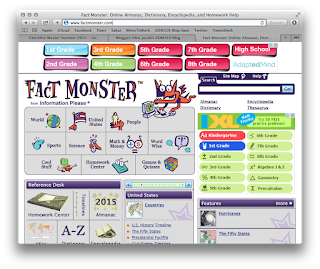
Fact Monster is "an ideal reference site for kid's ages 8-14 that provides entertainment and educational resources." It combines the contents of several sources such as a dictionary, almanac, encyclopedia, and atlas' which provides statistics, facts, and historical records. Compared to other search engines, it allows you to search them all at once. When you type in the search bar, it'll pull up different options from different sources to choose from, or you can choose from one of the four sources listed above. Overall, this would be more helpful for a research project for middle schoolers or for a more kid friendly version of a search.
3. Dog Pile
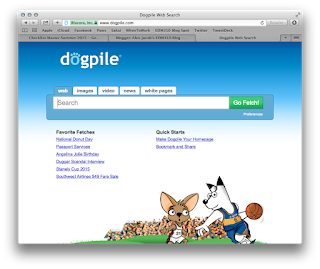
Dogpile is a search engine "powered by Metaseach technology, Dogpile returns all the best results from leading search engines, such as Google and Yahoo!, so you can find what you're looking for faster." Dogpile uses the method of choosing the most relevant to your search, removes duplicates, and presents them to you in seconds. It compiles all of the best results in one place, quickly and easily. This search engine would be best for anyone who likes the leading search engines, but it's more refined. It could be good to use for anyone, especially researching something broad.
4. Infotopia
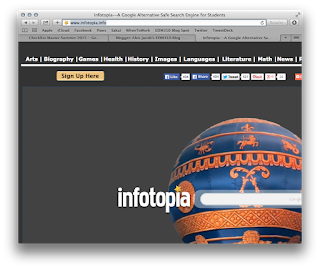
Infotopia is "an academic search engine accessing only trusted websites previously selected by librarians, teachers and the library." It is recommended for students, teachers and also homeschoolers. It is used to look up any subject at any time on the top line of the website, as well as search anything academical you would like. This could, again, be used for research papers in any topic or just in general. I feel this would be a good engine to use in my classroom when I become an educator because it includes tabs on literature and language.
5. Kayak
The search engine, Kayak, is mainly used for those traveling. It compares hundreds of travel sites at once which makes it easier to refine a search. You can also book anything on there once you find something that suits your travel needs, including: hotels, maps, and packaging deals. There is also a way to check flight and travel times on Kayak. This is not really a search engine to use in the classroom, but it is helpful for a vacation when it could be much needed or appreciated. Overall, a great engine for travelers.

6. Ask.com
Ask.com's mission is to provide answers across the globe for anyone at anytime. This website is a huge search engine meant for questions that link to, once searched, different search engines who have the answers to the questions. It is often meant to be used by someone who has a specific question and doesn't want a general answer from leading search engines. It is not the best source academically, but generally, it is great.

7. DuckDuckGo
DuckDuckGo is a search engine that allows users to search more privately and to get answers quicker. It's said to be "more than just servers and an algorithm." It has help from the community. DuckDuckGo has a very simple layout with the search bar and one button leading to a layout menu if you have further questions on the website. I appreciate that it is more private and clutter-free because there are less distractions. This can and could be helpful for any researcher.

8. Yahoo!
Yahoo! is similar to leading search engines such as Google and Bing. It is helpful all the way around when it comes to news, questions, weather, finance, sports, etc. Often people use Yahoo for their emails or just like any other popular search engine. When you type into the search bar what you are searching for, it pulls up different links in seconds for the researcher to interact with. This website is helpful for anyone, maybe even if you want a different view than Google or Bing.

1. Wolfram Alpha
Wolfram Alpha is a search engine that introduces a new way to get knowledge and answers, but it is more commonly known a computational knowledge engine. It says it is not done by searching the web, but by doing computations based on a vast collection of built-in data, algorithms, and methods. This engine gives the actual answers instead of leading you to other websites for the answers, it's all in one! Wolfram Alpha, I believe, is one everyone can use for a little leeway when we're stuck on a problem involving a formula. I do feel though, it can be relied on too often. I see it could be used more for typing the problem in just to receive answers, and not learn from the step by step instructions following.

2. Fact Monster
Fact Monster is "an ideal reference site for kid's ages 8-14 that provides entertainment and educational resources." It combines the contents of several sources such as a dictionary, almanac, encyclopedia, and atlas' which provides statistics, facts, and historical records. Compared to other search engines, it allows you to search them all at once. When you type in the search bar, it'll pull up different options from different sources to choose from, or you can choose from one of the four sources listed above. Overall, this would be more helpful for a research project for middle schoolers or for a more kid friendly version of a search.

3. Dog Pile
Dogpile is a search engine "powered by Metaseach technology, Dogpile returns all the best results from leading search engines, such as Google and Yahoo!, so you can find what you're looking for faster." Dogpile uses the method of choosing the most relevant to your search, removes duplicates, and presents them to you in seconds. It compiles all of the best results in one place, quickly and easily. This search engine would be best for anyone who likes the leading search engines, but it's more refined. It could be good to use for anyone, especially researching something broad.

4. Infotopia

5. Kayak
The search engine, Kayak, is mainly used for those traveling. It compares hundreds of travel sites at once which makes it easier to refine a search. You can also book anything on there once you find something that suits your travel needs, including: hotels, maps, and packaging deals. There is also a way to check flight and travel times on Kayak. This is not really a search engine to use in the classroom, but it is helpful for a vacation when it could be much needed or appreciated. Overall, a great engine for travelers.

6. Ask.com
Ask.com's mission is to provide answers across the globe for anyone at anytime. This website is a huge search engine meant for questions that link to, once searched, different search engines who have the answers to the questions. It is often meant to be used by someone who has a specific question and doesn't want a general answer from leading search engines. It is not the best source academically, but generally, it is great.

7. DuckDuckGo
DuckDuckGo is a search engine that allows users to search more privately and to get answers quicker. It's said to be "more than just servers and an algorithm." It has help from the community. DuckDuckGo has a very simple layout with the search bar and one button leading to a layout menu if you have further questions on the website. I appreciate that it is more private and clutter-free because there are less distractions. This can and could be helpful for any researcher.

8. Yahoo!
Yahoo! is similar to leading search engines such as Google and Bing. It is helpful all the way around when it comes to news, questions, weather, finance, sports, etc. Often people use Yahoo for their emails or just like any other popular search engine. When you type into the search bar what you are searching for, it pulls up different links in seconds for the researcher to interact with. This website is helpful for anyone, maybe even if you want a different view than Google or Bing.

Blog Post #4
Asking Questions: What Questions do we ask? How do we ask?
The Right Way to Ask Questions in the Classroom

In Ben Johnson's The Right Way to Ask Questions in the Classroom, he talks about the Goal of a Question, his Classroom Observations, and a Simple Effective Approach. Johnson focuses that the most important question to ask is, "What does a teacher asking questions of a class expect a class to learn from the questioning process?" Often times as teachers, we ask the question, "Does everyone understand?" The problem with this question is when no one answers, the students may not understand that they don't understand, and therefore won't know what to ask or how to answer. Johnson explains that this often times is a teachers way of saying, "This is your last chance. If you don't have questions then you must understand." He then goes on to ask, how do we appropriately check for understanding? The answer is ask specific questions.
In the section of Johnson's same blog, Classroom Observations, he points out students already have the labels, "smart", "not smart" or "don't care", by the fourth grade. These labels play a large role because the majority who are labeled "not smart" and "don't care" rely on the so called "smart" labeled students in the class. Teachers believe because a handful of students are answering the given questions, that all students in the classroom are learning from each other. Wrong. The 2/3's of the class not answering are day dreaming or thinking of other things than really diagnosing the answer. When Johnson shadowed a group of students for an extended period of time, he saw majority didn't ask a single question. Some students he followed didn't ask a question for a whole day and some didn't ask questions at all for a full month. Is there a strategy to help this? Johnson says yes.
In Johnson's final section, A Simple Effective Approach, he tells of a proposal by Mary Budd Rowe. Her proposal states: the teacher asks a question, pauses for three seconds and then picks a student individually to answer the question. This strategy allows them to automatically think of an answer when they are called on. Johnson says along with this strategy, ask and pick randomly so the students don't assume after they answer one question, that they are done for the day. I believe this strategy is one to keep in mind in order to be an effective teacher.
It is also proposed "open-ended" and "close-ended questions". A close-ended question can be answered simply by "yes" or "no". An open-ended question often promote deeper think and require a more in-depth answer. In Andi Stix's video, Open-Ended Questions, she gives several opening question starters.
Three Ways to Ask Better Questions in the Classroom
According to Maryellen Weimer in her blog, Three Ways to Ask Better Questions in the Classroom, she explains good questions make students think, encourage participation, and they improve answers students give and the questions that follow. Her 3 actions to improve the potential to improve our questioning as teachers is:
 1. Prepare Questions
Weimer says in her personal experience, she planned ahead for everything (lesson plans, activities, etc.) but never planned ahead her questions. This lead to random or spontaneous questions. She advises us to prepare questions to prevent any further confusion of the students than they were when you started asking random questions and then rephrasing them.
2. Play with Questions
Once questions are answered, often times students forget immediately afterwards the answer to the question. Weimer defines it: ask a question, let the students think on it and come back to it after a certain amount of time. This often encourages them to think beyond the surface.

3. Preserve Good Questions
Good questions can be kept. Sometimes it's best to jot down notes of what answers students offer and occasionally a student will ask a really good question and there will be reasons to save those later on as well.
Overall, Weimer tells us as educators, to work on questioning techniques, not just because they're more effective when skillfully answered, but so that students can see the importance of questions. Eventually students will ask better questions themselves, which Weimer claims is the best feeling of all.
What do we need to know about asking questions to be an effective teacher?
The Right Way to Ask Questions in the Classroom

In Ben Johnson's The Right Way to Ask Questions in the Classroom, he talks about the Goal of a Question, his Classroom Observations, and a Simple Effective Approach. Johnson focuses that the most important question to ask is, "What does a teacher asking questions of a class expect a class to learn from the questioning process?" Often times as teachers, we ask the question, "Does everyone understand?" The problem with this question is when no one answers, the students may not understand that they don't understand, and therefore won't know what to ask or how to answer. Johnson explains that this often times is a teachers way of saying, "This is your last chance. If you don't have questions then you must understand." He then goes on to ask, how do we appropriately check for understanding? The answer is ask specific questions.
In the section of Johnson's same blog, Classroom Observations, he points out students already have the labels, "smart", "not smart" or "don't care", by the fourth grade. These labels play a large role because the majority who are labeled "not smart" and "don't care" rely on the so called "smart" labeled students in the class. Teachers believe because a handful of students are answering the given questions, that all students in the classroom are learning from each other. Wrong. The 2/3's of the class not answering are day dreaming or thinking of other things than really diagnosing the answer. When Johnson shadowed a group of students for an extended period of time, he saw majority didn't ask a single question. Some students he followed didn't ask a question for a whole day and some didn't ask questions at all for a full month. Is there a strategy to help this? Johnson says yes.
In Johnson's final section, A Simple Effective Approach, he tells of a proposal by Mary Budd Rowe. Her proposal states: the teacher asks a question, pauses for three seconds and then picks a student individually to answer the question. This strategy allows them to automatically think of an answer when they are called on. Johnson says along with this strategy, ask and pick randomly so the students don't assume after they answer one question, that they are done for the day. I believe this strategy is one to keep in mind in order to be an effective teacher.
It is also proposed "open-ended" and "close-ended questions". A close-ended question can be answered simply by "yes" or "no". An open-ended question often promote deeper think and require a more in-depth answer. In Andi Stix's video, Open-Ended Questions, she gives several opening question starters.
Three Ways to Ask Better Questions in the Classroom
According to Maryellen Weimer in her blog, Three Ways to Ask Better Questions in the Classroom, she explains good questions make students think, encourage participation, and they improve answers students give and the questions that follow. Her 3 actions to improve the potential to improve our questioning as teachers is:
 1. Prepare Questions
Weimer says in her personal experience, she planned ahead for everything (lesson plans, activities, etc.) but never planned ahead her questions. This lead to random or spontaneous questions. She advises us to prepare questions to prevent any further confusion of the students than they were when you started asking random questions and then rephrasing them.
2. Play with Questions
Once questions are answered, often times students forget immediately afterwards the answer to the question. Weimer defines it: ask a question, let the students think on it and come back to it after a certain amount of time. This often encourages them to think beyond the surface.


3. Preserve Good Questions
Good questions can be kept. Sometimes it's best to jot down notes of what answers students offer and occasionally a student will ask a really good question and there will be reasons to save those later on as well.
Overall, Weimer tells us as educators, to work on questioning techniques, not just because they're more effective when skillfully answered, but so that students can see the importance of questions. Eventually students will ask better questions themselves, which Weimer claims is the best feeling of all.
Monday, June 1, 2015
Blog Post #3
 From three different sources, there is basically one underlying definition for peer editing. According to the first two sources, the definition for peer editing is: working with someone your own age to help improve his or her writing. In the video presentation, What is Peer Editing, and also the powerpoint presentation, Peer Edit with Perfection Tutorial, there are three steps in peer editing. The first step is to give compliments. The video and the power point mention to always stay positive and to always start with compliments. Thinking about your own blog, you wouldn't want someone to be harsh when editing your own blog, so put yourself in the other person's shoes and be positive. The second step is give suggestions. Suggestions can be defined as specific ideas on how to make writing better. As an editor, you must keep in mind the word choice, organization, the use of detail, sentences, and topic. Lastly, you make corrections. Again, you must approach in a formal and positive fashion. As the editor, look out specifically for punctuation, grammar, sentences, and spelling.

In the third and final resource, Writing Peer Review Top 10 Mistakes, students reenact how to not act when peer editing. The students share many examples, such as Picky Patty, Whatever William, Social Sammy, Jean the Generalizer, etc. All in all, the students are showing how not to be when you're editing someone else's paper, but in a funnier version than the first two sources. Overall, the steps to peer editing effectively, is to: compliment, suggest, and correct. Always stay positive; there has to be at least one good thing the blogger noted, so take note and show that you, as the editor, saw that. As peer editors, we are trying to improve, not tear down.
Saturday, May 30, 2015
Blog Post #2
What will teaching in the 21st Century be like?
Professor Dancealot
 There are many effective ways to teach, but the example shown in Professor Dancealot, by Karl Johnson, is a way that is not effective. The central message in this video is to show how Professor Dancealot used technology to teach his students simple dances and moves, but he did not apply it properly. The professor demonstrates to his students behind his podium. First off, this creates problems for students to learn efficiently when he is trying to teach visually. Instead of showing his steps in front of the students so they can see the presentation of foot work from power point interpreted to the literal dance moves, he disables the learning process by teaching the foot work behind the podium where no one can see and interpret the lesson properly. In effect, the students could not apply or retain the dance moves because they were not allowed out of their seats all semester. When the final arrived, the students were paired up and were given the opportunity to use their books during the exam, but it would not help them because they never applied or were taught the physical dance moves all semester. The case shows students must be engaged, otherwise it is not effective learning. The conclusion of this case could not be more justifiable and correct. How are students supposed to retain information if they have not applied it all semester or were never given a chance to ask questions? Many times students will stop learning and in result, move onto new things. This often happens in college and in high school. As teachers, we need to engage learning with our students, so we know our students can move onto better things because the results will show they succeeded greatly.
Teaching the 21st Century
In Teaching the 21st Century, Roberts shows many arguments of how teaching should be done in this day and age. Nowadays, he says, teachers are obsolete if they only teach facts in the classroom, so in order to be effective in the classroom, teachers must be facilitators. By doing this, teachers must learn skills from the internet such as blogging, Twittering, Facebooking, etc. like the kids have done. Students find anything, anywhere, and anytime. He also argues through several other examples:
I. Teachers must show students how to validate, synthesize, leverage, collaborate, communicate and problem solve.
a. Again, teachers must teach skills and not facts, which is what curriculum is currently based on.
b. Students need to learn how to CREATE, not just remembering, understanding, applying, analyzing, and evaluating skills.
II. Teachers must teach responsibility, reliability, and integrity because students are learning from friends, strangers and are also teaching themselves.
 III. Teachers must teach Professionalism.
IV. Teachers must create lessons that are relevant, challenging, and engaging.
V. He reminds us it is no longer about entertainment. Engagement is more active, it is for learning, it has long term results, it is meaningful and applicable, it solves problems, and it uses creativity of the participant. The list before shows how engagement differs from entertainment.
For teachers of the 21st century, it means we need to embrace technology because it is impactful and is now becoming the efficient way of teaching in school systems. Roberts arguments are interesting and I believe that he is saying in the nicest way possible that technology is taking over. As upcoming educators we may believe that old school is the way to go, but we need to change our thinking and embrace what is coming in our near future.
The Networked Student

In the video by Wendy Drexler entitled The Networked Student, I was told to pay very important attention to the question, "Why does the networked student even need a teacher?" The video answers the question by saying the teacher is the one who teaches him how to build this network and take advantage of learning opportunity. It then hit me like a sudden blow. I had the reaction of why did I not think of that? Wendy poses an argument that will make an educator, watching the video, really think. The student picks up information from the teacher because we are in a century where you can teach yourself but you still need guidance from the educator. Wendy says in order to help her student succeed, she taught him: how to communicate properly and respectfully with experts, shows how to differentiate between good information and propaganda, how to turn a web search into a scavenger hunt, and in return for her guidance, the educator got the reward of seeing her student get excited when he found the pearl of content. Generally, I agree with Wendy's teaching method and couldn't find her stance more correct. We are not yet in an age where teachers aren't needed, so we need to use them as guidance because they are useful sources. As an upcoming educator, we need to apply this style of teaching because it is about helping those successfully and not cutting them short. We are here to open new doors and to guide successfully.
Harness Your Students Digital Smarts

In the video, Harness Your Students Digital Smarts, Vicki Davis shares that she feels students need to be more diverse with technology. Davis believes only certain types of children succeed with a pencil and paper. Technology is more broad and it allows educators to focus on her students strengths and weaknesses. Nowadays, she says educators need to make sure that their students are more comfortable with any technology that could be thrown their way. She also believes teachers don't and shouldn't have to know everything. To this day, Davis admits she learns on a daily basis. I agree with Davis. Technology is overpowering our schools and we should be teaching children how to be comfortable with all types of technology, but at the same time they should not be spoon fed. Vicki admits that it is a wonderful feeling to see her students feeling of empowerment when they figure out a problem on their own. We want to teach children that they are invincible and well-rounded with technology and with each other. Once educators teach children how to be connected to the world, we empower our students and have a better classroom overall.
Who's Ahead in the Learning Race?
Dr. Strange doesn't give us the direct answer to the question in the video, Who's Ahead in the Race, although, it is inferred that elementary students are ahead in the technology race. As an undergraduate in college, it was difficult to watch the video and see how much further a third grader is along in technology than I was then and even now. When asked if I was technology literate when I first came into EDM310, I thought I was. I can now say I thought wrong. We see children nowadays with smartphones and as ridiculous as that may seem, that is how our world is revolving. Dr. Strange shows us in his visit to Gulf Shores Elementary School that even the children in Kindergarden are learning from day one. The students at Gulf Shores receive a Macbook Air once they progress into third grade and receive one every year following. Many school systems are pushing for taxes to be raised to provide technology for our students and it's spreading quickly. If this doesn't say something about how our generation is behind in the technology race, then I don't know what does.

Flipping the Classroom
Just when I thought I was up more up to date on technology, I was thrown for another loophole of seeing the new method of Flipping the Classroom. Ms. Mufano explains in the video, the lesson is given virtually the night before class for the children to watch. Students then can come in ahead of the game, knowing the lesson coming up, ready to discuss and ask questions. Being ahead of the game shows time being used efficiently. Although there are many expectations, I feel once this system has evolved in all classroom settings, it'll be more efficient. The video stated the subject it's only available in is math so far. Once the flip reaches all subjects, educators can teach students to adjust once they make it apart of the curriculum, making a more efficient use of time in all classrooms in the future.

As an educator, I'm not sure whether it would efficient for my profession or not. I believe it would come with time and training and also time and effort. It would take experimentation in my own classroom before I could completely switch over. As a English major, students are required to read the night before regardless and if they can't do it now, why would it change by assigning a video? Although, I don't want to doubt a upcoming method, so I would be willing to experiment before I agreed to going through with it or not.
Bringing the Locker Room into the Classroom
In the article Bringing the Locker Room into the Classroom by Craig Owens, there is a specific approach he is trying to take. Owens is similarly an English professor, as I am a major. When I read his article, I found his formula to be very useful for when I become a teacher. His formula follows the guidelines of: recognizing patterns, formulating questions and crafting interpretative responses. Owens claims with time, this formula becomes more natural. As a student now, I feel that this process would help if my English professors knew of it. It is said that students need a routine, deeply analyzing content. As student, we should not remotely focus and ask the teacher to spit out the answers or define questions for us and in return, teachers should not be regurgitating the the same questions on exams. With English, comes interpretation but I feel that I've been taught wrong my whole schooling career. I, as an educator, want to change to Owens scenario, for a better working and teaching environment for my future students.
Professor Dancealot
 There are many effective ways to teach, but the example shown in Professor Dancealot, by Karl Johnson, is a way that is not effective. The central message in this video is to show how Professor Dancealot used technology to teach his students simple dances and moves, but he did not apply it properly. The professor demonstrates to his students behind his podium. First off, this creates problems for students to learn efficiently when he is trying to teach visually. Instead of showing his steps in front of the students so they can see the presentation of foot work from power point interpreted to the literal dance moves, he disables the learning process by teaching the foot work behind the podium where no one can see and interpret the lesson properly. In effect, the students could not apply or retain the dance moves because they were not allowed out of their seats all semester. When the final arrived, the students were paired up and were given the opportunity to use their books during the exam, but it would not help them because they never applied or were taught the physical dance moves all semester. The case shows students must be engaged, otherwise it is not effective learning. The conclusion of this case could not be more justifiable and correct. How are students supposed to retain information if they have not applied it all semester or were never given a chance to ask questions? Many times students will stop learning and in result, move onto new things. This often happens in college and in high school. As teachers, we need to engage learning with our students, so we know our students can move onto better things because the results will show they succeeded greatly.
Teaching the 21st Century
In Teaching the 21st Century, Roberts shows many arguments of how teaching should be done in this day and age. Nowadays, he says, teachers are obsolete if they only teach facts in the classroom, so in order to be effective in the classroom, teachers must be facilitators. By doing this, teachers must learn skills from the internet such as blogging, Twittering, Facebooking, etc. like the kids have done. Students find anything, anywhere, and anytime. He also argues through several other examples:
I. Teachers must show students how to validate, synthesize, leverage, collaborate, communicate and problem solve.
a. Again, teachers must teach skills and not facts, which is what curriculum is currently based on.
b. Students need to learn how to CREATE, not just remembering, understanding, applying, analyzing, and evaluating skills.
II. Teachers must teach responsibility, reliability, and integrity because students are learning from friends, strangers and are also teaching themselves.
III. Teachers must teach Professionalism.IV. Teachers must create lessons that are relevant, challenging, and engaging.
V. He reminds us it is no longer about entertainment. Engagement is more active, it is for learning, it has long term results, it is meaningful and applicable, it solves problems, and it uses creativity of the participant. The list before shows how engagement differs from entertainment.
For teachers of the 21st century, it means we need to embrace technology because it is impactful and is now becoming the efficient way of teaching in school systems. Roberts arguments are interesting and I believe that he is saying in the nicest way possible that technology is taking over. As upcoming educators we may believe that old school is the way to go, but we need to change our thinking and embrace what is coming in our near future.
The Networked Student

In the video by Wendy Drexler entitled The Networked Student, I was told to pay very important attention to the question, "Why does the networked student even need a teacher?" The video answers the question by saying the teacher is the one who teaches him how to build this network and take advantage of learning opportunity. It then hit me like a sudden blow. I had the reaction of why did I not think of that? Wendy poses an argument that will make an educator, watching the video, really think. The student picks up information from the teacher because we are in a century where you can teach yourself but you still need guidance from the educator. Wendy says in order to help her student succeed, she taught him: how to communicate properly and respectfully with experts, shows how to differentiate between good information and propaganda, how to turn a web search into a scavenger hunt, and in return for her guidance, the educator got the reward of seeing her student get excited when he found the pearl of content. Generally, I agree with Wendy's teaching method and couldn't find her stance more correct. We are not yet in an age where teachers aren't needed, so we need to use them as guidance because they are useful sources. As an upcoming educator, we need to apply this style of teaching because it is about helping those successfully and not cutting them short. We are here to open new doors and to guide successfully.
Harness Your Students Digital Smarts

In the video, Harness Your Students Digital Smarts, Vicki Davis shares that she feels students need to be more diverse with technology. Davis believes only certain types of children succeed with a pencil and paper. Technology is more broad and it allows educators to focus on her students strengths and weaknesses. Nowadays, she says educators need to make sure that their students are more comfortable with any technology that could be thrown their way. She also believes teachers don't and shouldn't have to know everything. To this day, Davis admits she learns on a daily basis. I agree with Davis. Technology is overpowering our schools and we should be teaching children how to be comfortable with all types of technology, but at the same time they should not be spoon fed. Vicki admits that it is a wonderful feeling to see her students feeling of empowerment when they figure out a problem on their own. We want to teach children that they are invincible and well-rounded with technology and with each other. Once educators teach children how to be connected to the world, we empower our students and have a better classroom overall.
Who's Ahead in the Learning Race?
Dr. Strange doesn't give us the direct answer to the question in the video, Who's Ahead in the Race, although, it is inferred that elementary students are ahead in the technology race. As an undergraduate in college, it was difficult to watch the video and see how much further a third grader is along in technology than I was then and even now. When asked if I was technology literate when I first came into EDM310, I thought I was. I can now say I thought wrong. We see children nowadays with smartphones and as ridiculous as that may seem, that is how our world is revolving. Dr. Strange shows us in his visit to Gulf Shores Elementary School that even the children in Kindergarden are learning from day one. The students at Gulf Shores receive a Macbook Air once they progress into third grade and receive one every year following. Many school systems are pushing for taxes to be raised to provide technology for our students and it's spreading quickly. If this doesn't say something about how our generation is behind in the technology race, then I don't know what does.

Flipping the Classroom
Just when I thought I was up more up to date on technology, I was thrown for another loophole of seeing the new method of Flipping the Classroom. Ms. Mufano explains in the video, the lesson is given virtually the night before class for the children to watch. Students then can come in ahead of the game, knowing the lesson coming up, ready to discuss and ask questions. Being ahead of the game shows time being used efficiently. Although there are many expectations, I feel once this system has evolved in all classroom settings, it'll be more efficient. The video stated the subject it's only available in is math so far. Once the flip reaches all subjects, educators can teach students to adjust once they make it apart of the curriculum, making a more efficient use of time in all classrooms in the future.

As an educator, I'm not sure whether it would efficient for my profession or not. I believe it would come with time and training and also time and effort. It would take experimentation in my own classroom before I could completely switch over. As a English major, students are required to read the night before regardless and if they can't do it now, why would it change by assigning a video? Although, I don't want to doubt a upcoming method, so I would be willing to experiment before I agreed to going through with it or not.
Bringing the Locker Room into the Classroom

In the article Bringing the Locker Room into the Classroom by Craig Owens, there is a specific approach he is trying to take. Owens is similarly an English professor, as I am a major. When I read his article, I found his formula to be very useful for when I become a teacher. His formula follows the guidelines of: recognizing patterns, formulating questions and crafting interpretative responses. Owens claims with time, this formula becomes more natural. As a student now, I feel that this process would help if my English professors knew of it. It is said that students need a routine, deeply analyzing content. As student, we should not remotely focus and ask the teacher to spit out the answers or define questions for us and in return, teachers should not be regurgitating the the same questions on exams. With English, comes interpretation but I feel that I've been taught wrong my whole schooling career. I, as an educator, want to change to Owens scenario, for a better working and teaching environment for my future students.
Blog Post #1
Outline
I. Things I've heard
II. Fears
III. Compare and Contrast
IV. Most difficult thing
V. Best way to Address my Fear
VI. What Questions Do I Have?
 EDM310 is a course that every education major has heard, known and or talked about. Personally, I've heard EDM310 is time consuming. Most classes take a lot of time, but previous students have told me that no other class can beat the time consumption of this one, especially over the summer. Not only that, but I've also heard it to be the class "to teach you how to use smart boards and the class that constantly blogs." I know there is more to it than that, which leads me to my fears I have for this course.

My fears consist of having thoughts that I'm going to miss, forget, or overthink the assignments. Overthinking is one of my flaws that has turned into a fear since coming to college. Even when I know I have completed the assignments on time, I still believe there is always something missing.

EDM310 is similar to courses I've taken in college, in which there are lectures, the concept of individualism, and demonstrated assessments. The difference I find is the time management EDM310 requires. With the many different assignments with different due dates, there is a lot more individualized planning and time management required.
On a similar note, I believe the most difficult thing for me in this course is to not come in and ask for step by step instructions because I'm going to constantly think I'm doing things wrong. I believe I would do this because I'm so used to burp-back education. Being so used to a certain habit is hard to break and I'm trying to keep an open mind for what this semester brings.
 Although I have my fears, I can overcome them. The best way to address my fear is to go to labs daily, get the lab assistants and Dr. Strange to know my name and face, and to take a deep breath and dive into assignments and finish out strong. All of these ways, except for the last one, is listed over and over in our syllabus and other documents. I take this to be a hint, hint to come ask questions and or take use of the time in the lab.

I believe the same goes for questions. I don't have any questions right off, but I know for sure when I do have them that I will visit the lab and the assistants to get them answered. I'm looking forward to gaining new knowledge about technology and how to apply it as an educator. Already, thus far in the course, I have learned how much our schools are relying and revolving around technology. It's very exciting to see the changes evolve and I can't wait to see what is in store this semester.
I. Things I've heard
II. Fears
III. Compare and Contrast
IV. Most difficult thing
V. Best way to Address my Fear
VI. What Questions Do I Have?
 EDM310 is a course that every education major has heard, known and or talked about. Personally, I've heard EDM310 is time consuming. Most classes take a lot of time, but previous students have told me that no other class can beat the time consumption of this one, especially over the summer. Not only that, but I've also heard it to be the class "to teach you how to use smart boards and the class that constantly blogs." I know there is more to it than that, which leads me to my fears I have for this course.

My fears consist of having thoughts that I'm going to miss, forget, or overthink the assignments. Overthinking is one of my flaws that has turned into a fear since coming to college. Even when I know I have completed the assignments on time, I still believe there is always something missing.

EDM310 is similar to courses I've taken in college, in which there are lectures, the concept of individualism, and demonstrated assessments. The difference I find is the time management EDM310 requires. With the many different assignments with different due dates, there is a lot more individualized planning and time management required.
On a similar note, I believe the most difficult thing for me in this course is to not come in and ask for step by step instructions because I'm going to constantly think I'm doing things wrong. I believe I would do this because I'm so used to burp-back education. Being so used to a certain habit is hard to break and I'm trying to keep an open mind for what this semester brings.
 Although I have my fears, I can overcome them. The best way to address my fear is to go to labs daily, get the lab assistants and Dr. Strange to know my name and face, and to take a deep breath and dive into assignments and finish out strong. All of these ways, except for the last one, is listed over and over in our syllabus and other documents. I take this to be a hint, hint to come ask questions and or take use of the time in the lab.

Wednesday, May 27, 2015
Practice Post: Who am I? Why do I want to be an educator? What does an educator do in his or her practice? What are my passions?
Outline
I. Description of Self: Name, Hometown, Family
II. Description of School: High School, College, Major
III. Description of Deciding to be a Teacher: The Influence
IV.Description of what a Teacher should be: Characteristics
V. Description of my Passions: English, Color Guard
My name is Alex Jacob. I am not from Mobile, but I'm originally from Decatur, Alabama. It's about four, to four and a half hours north, depending on how heavy your foot is. My parents are divorced, but even with two sets of parents I have one sister who is an upcoming senior. After the upcoming school year, my sister and I will have both graduated from Decatur High School and moved onto South. I am currently a secondary education in English major, but I wasn't to start out with.
I didn't see myself becoming a teacher as I grew older. It was always my dream as a kid because both my mom and her parents were apart of our local school system. I started as a Pre-PT major my freshman year and finally figured out that my passion has always destined to be teaching. I decided my place was English because it was my best subject and I wanted to help upcoming generations get back on track to proper English. I want to build on teaching English and taking every course to make me a better educator. An educator is supposed to be a leader, a coach and one to push to the furthest extent to help someone succeed. I am majorly interested in band, my passion specifically being color guard. It has been a passion of mine since I began high school and I also pursued it here at South. Surprisingly, it is the reason I came to South. It helped me branch out and find people to talk to about changing over to education. Color guard led me to finding a passion I can pursue in life.

Tuesday, May 26, 2015
My Test Post Title
This is my First Post. I hit the HTML button which I should always do in EDM310. I am now a Blogger!
Subscribe to:
Posts (Atom)